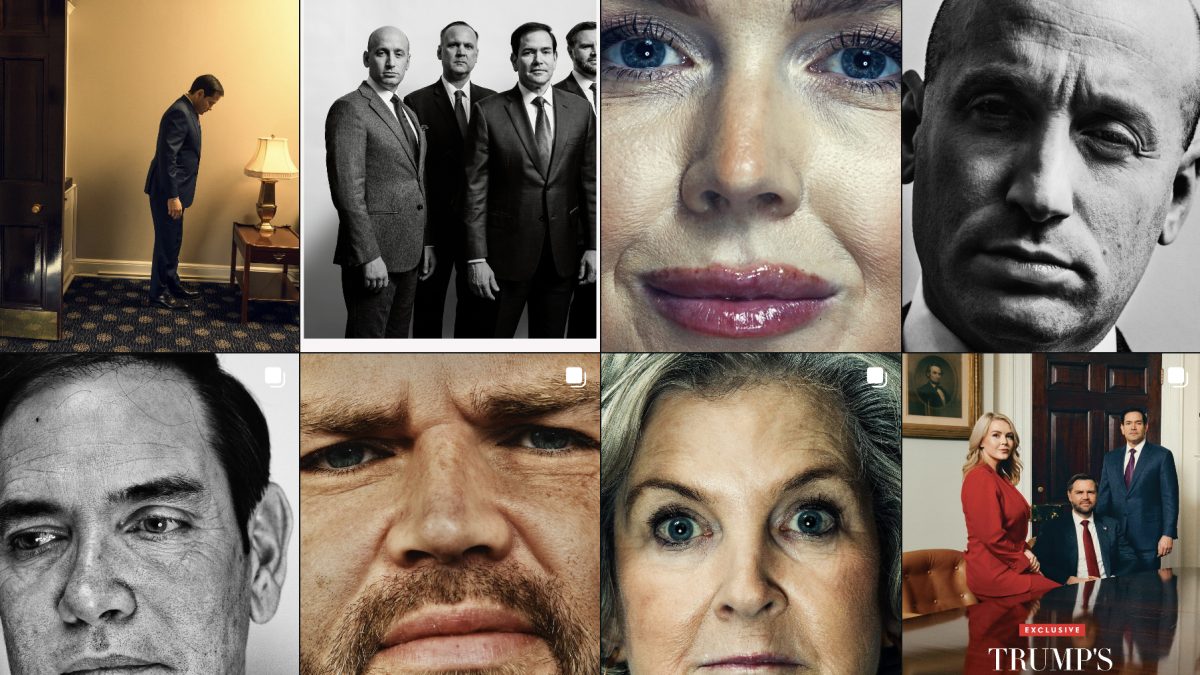
On Dec. 16, 2025, Vanity Fair magazine posted their yearly article on American politics. It was an off-the-record interview with the White House Chief of Staff Susie Wiles, in which she describes working with the President and all of the “Junkyard Dogs” such as Vice President JD Vance, Press Secretary Karoline Leavitt, Homeland Security Advisor Stephen Millerand Secretary of State Marco Rubio. The article was structured on how Wiles mentioned each of the Junkyard Dogs with at least two photographs of each person.
Although the unfiltered report of the members of the Oval Office was intriguing, the photographs were even more captivating. The photos were each unique in their own way and most of them were close ups. Each photo was unique and eye-catching for different reasons. For example, one close up of Levitt clearly defined her lip injection scars. In a photo of Wiles, her eyes are bloodshot and her pupils are small, and in a photo of Rubio you can see the loose hair strands laying on his forehead.
These photos sparked backlash from the Trump administration, claiming that this was an attack on the government and an unfair representation of our political leaders. Christopher Anderson, the photographer for the Vanity Fair article, faced negative opinions for weeks after the article was published. He was interviewed by the Independent, where he was asked if his intention was to make these political leaders look bad.
His response was that the photos were not taken with the intention of sparking any backlash, and in fact, he has done this close-up style of photojournalism for years because he “likes the idea of penetrating the theater of politics.” This statement sparked a question for me: Was the backlash resulting from the article justified?
Student Photographer, Ella Kurhajec, a junior at MHS, says the backlash is justified. Kurhajec said she thinks Anderson had a clear motive going into this project.
“I think he (Anderson) definitely knew what he was doing… I think they’re meant to be provocative and scary in a way,” Kurhajec said. As a photographer, Kurhajec said she understands the rules needed in order to take a “good looking” photograph of someone, and she believes that Anderson purposefully did not follow these rules.
“I think every photographer at a level such as Christopher Anderson knows how to take ‘standard’ portrait photos.” Kurhajec explains. “I think he very clearly broke that standard and went for a more creative version.”
Kurhajec also responded to Anderson’s statement, saying, “He even makes the argument that that’s just their real self. I think you could make that about anybody.” Kurhajec said she believes Anderson is just trying to get himself out of the heat of the US media and that any photographer could make the statement that their work is just “showing their subject’s real self.”
Some believe that the backlash is not justified, like MHS 11th grader and aspiring entrepreneur Lorenzo Sansone. He said he thinks that the photographs were not meant to be attacks, but, instead, honest representations of the people in power.
“If I want to take a photo of somebody and make them look bad, there are obvious ways to do that,” Sansone explained. “But even if someone looks bad in a photo, it can still be a true representation of who they are in one way or another.”
From his perspective, discomfort does not automatically mean manipulation. Sansone also explains that close-up photography removes the performative nature of politics.
“What close-up photography does is remove the performance,” Sansone said. “It strips away the polish and shows people without the usual political theater around them.” Politicians are trained to look a certain way in the media, and these images challenge that expectation, he said.
Sanson also noted that photography is never fully neutral. “At the end of the day, photography is opinionated,” Sansone said. He found it interesting that most of the anger came from the political right. “They kept asking, ‘Why are you showing this?’ But these are just what these people look like.”
Some people fall somewhere in between the sides of the argument, including retiree Michael Higgins. Higgins said he believes that personal bias plays a large role in how the images are received. “If these photos were of people I admired, I’d probably appreciate them more,” Higgins said. “My feelings toward the subjects absolutely affect how I see the images.” This shows how political views can influence whether the photos are seen as truthful or disrespectful.
He acknowledges the power photographers have in shaping narratives. “Photojournalists can direct the narrative of what they want people to understand,” Higgins said. “If you approach a project supporting the president, you’re going to look for the good. If you don’t support him, you’re going to find something very different.”
In the end, the controversy surrounding the Vanity Fair article raises a larger question about the purpose of political photography and photojournalism. Whether the backlash is justified depends on how people believe politicians should be presented to the public. The strong reactions to these images suggest that when political figures are shown without polish or performance, it can be uncomfortable, but also revealing.